
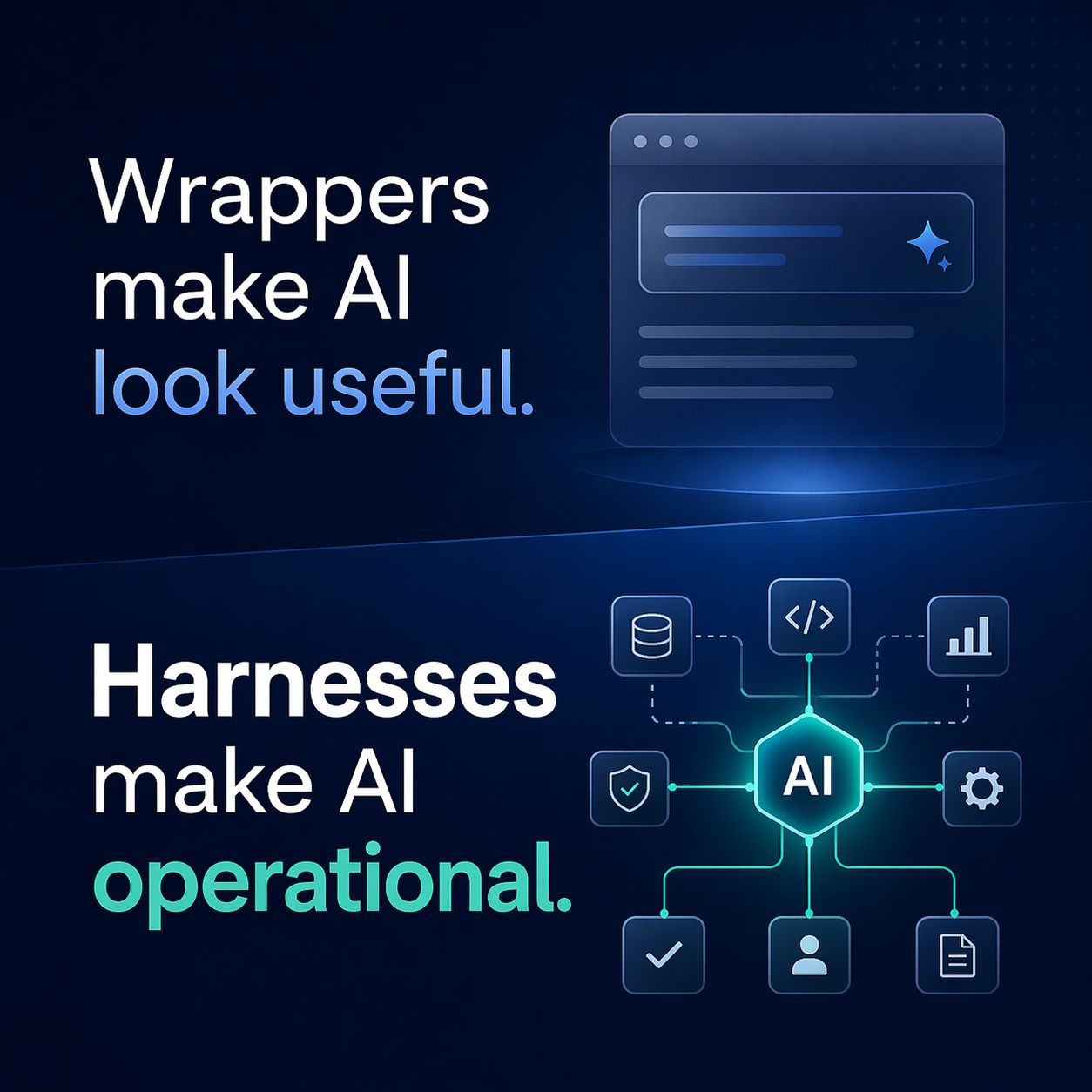
Wrappers Make AI Look Useful. Harnesses Make AI Operational.
Thin AI interfaces impress in demos; durable value comes from workflow context, tools, permissions, and traceability around the model.
Most business AI projects still start in the same place.
Someone sees what ChatGPT can do. Someone connects an AI model to a form, a chatbot, a document, or an internal tool. The demo looks impressive.
Then reality shows up.
The AI does not know enough context. It cannot access the right tools. It forgets what happened before. It gives an answer, but the work still has to be completed manually. It creates more review work instead of removing operational friction.
That is the difference between an AI wrapper and an AI harness.
A wrapper makes AI look useful.
A harness makes AI operational.
What Is an AI Wrapper?
An AI wrapper is usually a thin interface around a model.
It might be a chatbot on a website. It might be a prompt connected to a button. It might be a simple tool that sends data to an AI model and returns a response.
There is nothing wrong with wrappers. They can be helpful. They can improve user experience. They can make existing tools easier to interact with.
But wrappers have a ceiling.
They usually depend on the user to provide the right context, ask the right question, check the answer, move information into the next system, and decide what should happen next.
In other words, the AI may generate something useful, but the business process still depends on manual work.
That is why so many AI experiments feel exciting at first and disappointing a few weeks later.
The model is not the whole system.
What Is an AI Harness?
An AI harness is the operating layer around the model.
It gives the AI the structure it needs to participate in real work, not just generate responses.
A strong AI harness can include:
- business context
- workflow rules
- tool access
- memory
- permissions
- human approvals
- feedback loops
- error handling
- logging and traceability
- escalation paths
The goal is not just to get a better answer from the AI.
The goal is to help the AI complete part of a workflow safely, consistently, and in the right business context.
That distinction matters.
A model can summarize an email. A harnessed AI system can read the email, classify the request, check the CRM, draft the response, route it for approval, update the customer record, and notify the right person if something needs human attention.
That is a different level of value.
The Business Problem Is Not “We Need AI”
Most companies do not have an AI problem.
They have workflow problems.
Work gets stuck between tools. Teams copy and paste information from one system to another. Approvals happen in Slack, email, spreadsheets, and memory. Documents are reviewed manually. Leads are not followed up consistently. Reports take too long to prepare. Customer requests get handled differently depending on who is available.
Adding AI on top of that mess does not automatically fix it.
Sometimes it just makes the mess faster.
This is where many companies make the wrong investment. They look for an AI tool before they understand the workflow.
They ask:
“What AI product should we use?”
But the better question is:
“What work should the AI actually help complete, and what system does it need around it to do that reliably?”
Why Wrappers Break in Real Operations
Wrappers tend to work well in controlled demos because demos are simple.
The input is clean. The edge cases are hidden. The user knows what to ask. The output does not have to survive a real operational process.
Real workflows are different.
A customer sends incomplete information. A document has missing fields. A lead does not match the ideal profile. A task requires approval before moving forward. A system has outdated data. A teammate already handled part of the request. A mistake creates compliance or customer risk.
In those situations, a wrapper is not enough.
The AI needs to know what to do next. It needs access to the right data. It needs boundaries. It needs a way to ask for approval. It needs to log what happened. It needs to fail safely.
That is what a harness provides.
What an AI Harness Looks Like in Practice
For a business, an AI harness does not need to sound technical.
Think of it as the system that answers these questions:
What context does the AI need? The AI should not operate only from a prompt. It needs relevant information from the business: customer records, process rules, documents, previous interactions, product data, pricing logic, or internal policies.
What tools can the AI use? Can it search files? Read emails? Update a CRM? Create a task? Draft a document? Trigger an automation? Pull data from a spreadsheet?
What is it allowed to do? Some actions can be automated. Others need approval. Some should be blocked entirely. A useful AI system needs clear permission boundaries.
When should a human be involved? Good automation does not remove humans from everything. It removes unnecessary manual work and brings humans in when judgment, risk, or approval matters.
How does the system improve over time? The AI should not be a black box. The business needs logs, review points, performance feedback, and visibility into where the system is helping or failing.
This is what turns AI from a feature into infrastructure.
Example: Lead Management
A wrapper approach to lead management might look like this:
A user pastes a lead into a chatbot and asks, “Is this a good fit?”
The AI gives a response.
That may be useful, but it still leaves a lot of manual work.
A harnessed AI system would work differently.
A new lead enters the pipeline. The system enriches the lead using available sources. The AI evaluates fit based on defined criteria. It checks whether the company matches the target customer profile. It assigns a priority score. It drafts a recommended next step. It routes high-value leads to a human. It updates the CRM. It logs the reasoning. It tracks whether the recommendation led to a useful outcome.
Now the AI is not just answering a question.
It is participating in the workflow.
That is the difference.
Example: Document Processing
A wrapper approach might allow someone to upload a document and ask the AI to summarize it.
Again, useful.
But in a real business process, summarization is rarely the full job.
A harnessed document workflow could:
- receive documents from email or an upload form
- classify the document type
- extract key fields
- validate missing or inconsistent information
- compare data against internal records
- route exceptions to a human
- store the document in the right place
- update the operational system
- create an audit trail
The business outcome is not “we used AI to summarize a PDF.”
The outcome is faster processing, fewer manual checks, better consistency, and stronger visibility.
Why This Matters for SMBs
For small and mid-sized service businesses, this distinction is especially important.
Most lean teams do not need a large AI transformation program.
They need practical systems that remove bottlenecks.
They need faster intake. Cleaner handoffs. More consistent follow-up. Less manual reporting. Fewer copy-paste tasks. Better visibility into what is waiting, stuck, or at risk.
A wrapper may help someone move faster for a moment.
A harness improves how the operation runs.
That is where the return comes from.
The Real Value Is Workflow Design
The businesses that get value from AI are not necessarily the ones using the most advanced model.
They are the ones that design better systems around the model.
They define the workflow. They decide where AI should assist. They identify what should stay human. They set permission boundaries. They connect the right tools. They measure whether the system actually improves the business.
This is why diagnosis matters before implementation.
If you automate the wrong workflow, you get complexity without leverage.
If you add AI to a broken process, you often make the process harder to manage.
But if you start with the actual operational pain, map the workflow, and then design the right harness around the AI, the system becomes much more useful.
A Simple Test
If you are evaluating an AI solution, ask this:
Does it only generate an output?
Or does it help complete the work?
If it only generates an output, it is probably a wrapper.
If it can operate within a workflow, use tools, respect permissions, involve humans at the right moments, and improve execution, then you are moving toward a harness.
That is the shift businesses should care about.
Not AI for the sake of AI.
AI inside systems that make work easier, faster, and more consistent.
Final Thought
Wrappers make AI look useful.
Harnesses make AI operational.
The difference is not cosmetic. It is the difference between a demo and a business system.
For most companies, the next step is not buying another AI tool.
It is understanding which workflows are worth improving, what role AI should play, and what operating layer needs to exist around it.
Because the model is only one part of the solution.
The system around it is what creates the business value.