
Why AI Is Quietly Favoring Small Teams
AI does not automatically reward scale—it rewards teams small enough to turn efficiency into shipped work, judgment, and durable systems.
The default story in AI is that incumbents win: more compute, more data, more budget.
On the ground, a different pattern is showing up. Large organizations often feel more productive after rolling out AI tools. Lean teams often become more productive—and the gap is widening in the small team's favor.
Call it a productivity paradox. Enterprise gains get absorbed by organizational tax—extra meetings, approval layers, and process designed to manage complexity. A two-person operator team, or a founder-led company with ten people, can redirect the same 20% efficiency lift into the next feature, the next client segment, or the next workflow fix.
If you run a small business, that asymmetry is not theoretical. It is structural.
Here are four counter-intuitive truths worth internalizing before your next AI initiative.
1. Small teams convert AI gains into output—not into headcount theater
In a large company, AI-driven productivity is often framed as cost reduction: do the same work with fewer hours, report savings upward, keep the org chart intact.
In a lean business, the same lift is a force multiplier. Automate intake, reporting, or follow-up—and the hours do not disappear into a status meeting. They show up as:
- faster cycle times on core workflows
- one person covering a lane that used to need two
- quicker experiments because there is no "institutional middle" between idea and ship
The difference is not tool access. Both sides can buy the same subscriptions. The difference is what happens after the save.
If your team cannot point to what you shipped—or improved in production—because of AI in the last 30 days, you are not behind on tools. You are behind on conversion.
Takeaway: Treat every automation as a redirect of energy toward output, not as a line item for next quarter's budget review.
2. The moat moved upstream of "we can build this"
Engineering difficulty is decaying fast. Workflows that used to justify whole product lines can be prototyped in a weekend with assisted development.
If your advantage is only "we know how to build this," that moat is evaporating.
What compounds now sits upstream of the build:
| Pillar | What it means in practice |
|---|---|
| Proximity to the problem | You see the real bottleneck—approvals, handoffs, exceptions—not a sanitized ticket description. |
| Partnership with domain expertise | You integrate knowledge AI cannot invent: compliance nuance, how deals actually close, how ops really runs on Friday afternoon. |
| Discipline in problem selection | You choose what is worth solving before you optimize how fast you can solve it. |
Proximity is the opportunity. Transferability is what makes it a business.
A one-off prompt fix helps once. A repeatable workflow—with clear inputs, owners, and failure modes—helps every week. That is the shift from demo to operating system.
Takeaway: Compete on judgment and proximity, then encode what works so it survives the next hire and the next model upgrade.
3. Sparring partner beats answer machine
There is a seductive mode of using AI: ask, accept, ship.
When you ship output you cannot explain, you are not being productive—you are taking on operational debt. Six months later, the difference shows up in who can defend a decision when something breaks, a client asks why, or an auditor asks how.
The durable pattern is sparring partner:
- challenge your own logic before you commit
- stress-test edge cases on workflows and data handling
- use the model to explore alternatives, not to replace your accountability
The operators who compound are the ones who can explain the why behind what they automated—not just the button they clicked.
Takeaway: If you cannot explain it to a client, a teammate, or your future self, it is not ready for production dependency.
4. Demos are cheap; production responsibility is not
In the LLM era, impressive interfaces are easy. Production is what happens when someone depends on you—and calls when it breaks.
Small scale does not mean low consequence. The moment a customer, partner, or internal team relies on your system, you inherit uptime, data integrity, and trust.
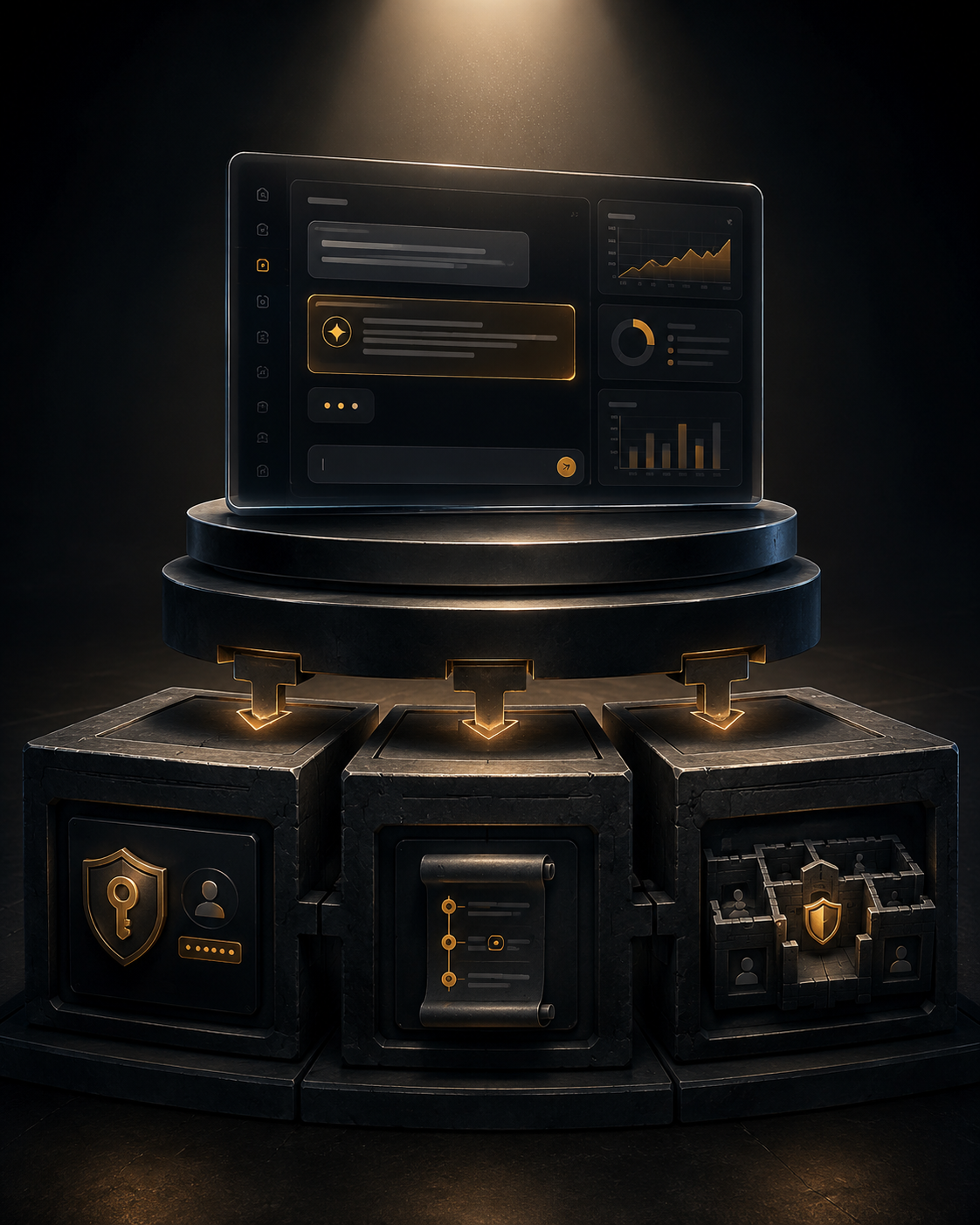
Many builders discover too late that AI helped them paint the UI but not pass a serious review. Three foundations that are painful to retrofit—and that lose B2B deals when missing:
- Role-based access — who can see and change what, by design
- Audit trails — what happened, when, and under whose authority
- Tenant isolation — hard boundaries between customer data
Skip these and you did not build a product. You built a liability with a good demo.
Takeaway: Build for the review you will face at your next stage of growth, not for the screenshot you will post this week.
Where this leaves you in 2026
The industry is splitting into two camps:
- AI that helps people build and run systems — augmentation with clear ownership
- AI that runs systems with less human touch — automation with governance
Both are valid. Confusion is expensive when you mix them in the same workflow without naming which mode you are in.
Ask structurally:
- Are you positioned to absorb AI gains into your own growth—or only to maintain legacy process until it is automated away?
- Do you know where judgment ends and execution begins in your core workflows?
The scarce asset is not the code. It is the operational judgment to decide what to automate, what to augment, and what must stay human—with receipts.
Next step
If you want a clear picture before you buy more tools, start with workflow clarity—not another pilot.
Book an AI Operations Assessment — we map where AI should augment your team versus where it should run repeatable work, with priorities you can defend.