
Cognitive Labor Is Getting Cheaper: Where Value Moves Next
Execution capacity is becoming abundant. The new bottleneck is direction, judgment, and workflow clarity.
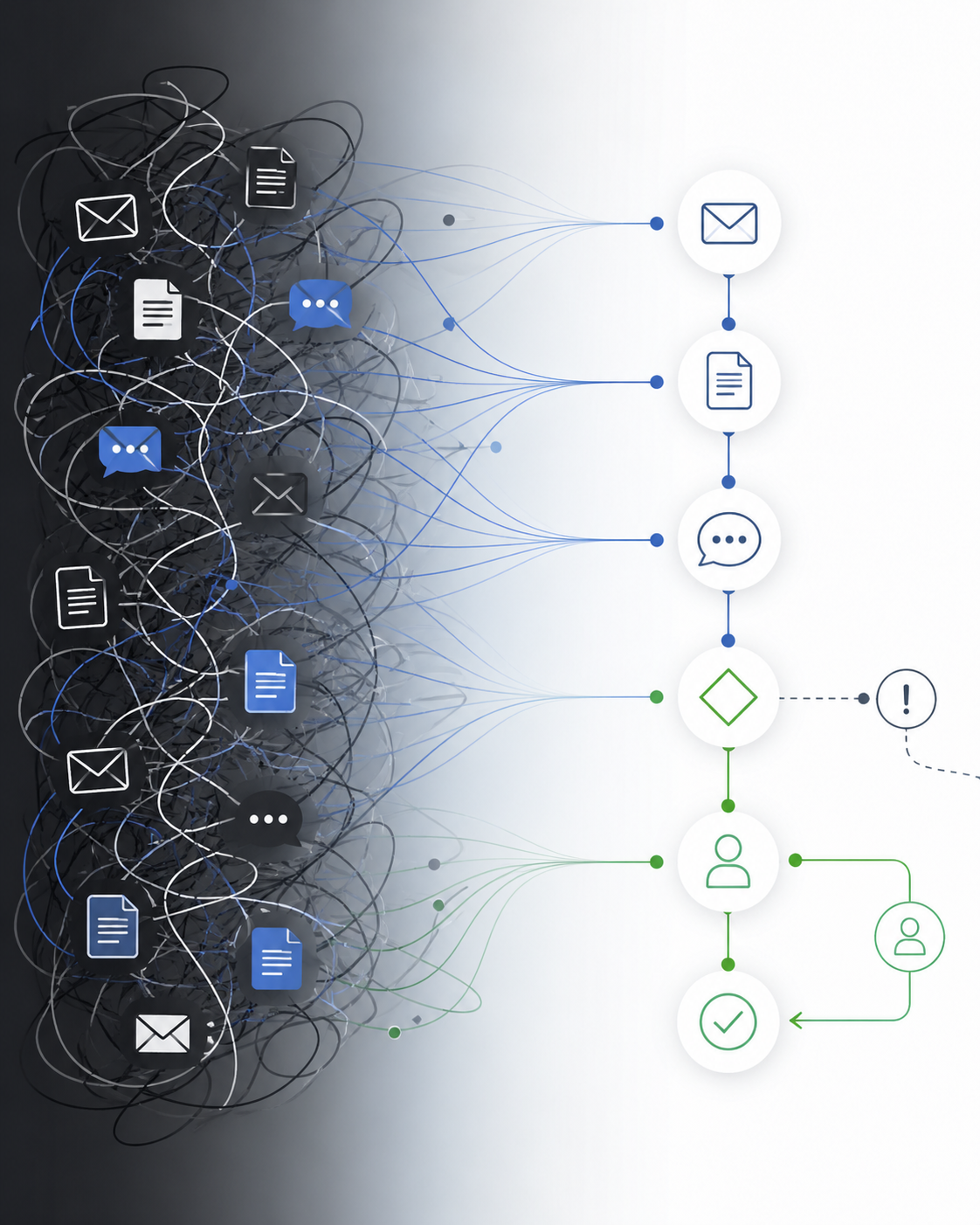
For years, high-value knowledge work was defined by execution strength. The people who could ship faster, analyze more data, and process more complexity held the advantage.
That advantage is compressing.
AI systems now handle large portions of drafting, summarization, coding support, document extraction, and analytical synthesis. Work that previously took days can now be produced in hours or minutes. This does not remove the need for talent. It changes where talent creates value.
The core shift is simple: execution capacity is becoming abundant, but directional clarity is still scarce.
The bottleneck moved up the stack
In many organizations, the limiting factor is no longer “Can we produce this output?” It is:
- What should we produce first?
- What quality threshold defines done?
- Which outputs matter to business outcomes?
- Who owns decisions when trade-offs appear?
Without clear answers, teams scale activity faster than they scale value. AI makes this worse when governance is weak. You get more content, more artifacts, more velocity, and the same strategic confusion.
Why throughput alone no longer differentiates
When execution is expensive, throughput is a moat.
When execution gets cheaper, throughput is table stakes.
That means advantage moves toward higher-order capabilities:
1) Direction
The ability to define the right problem before work begins.
2) Judgment
The discipline to choose what to prioritize, reject, or defer.
3) Synthesis
The skill to integrate outputs from multiple systems into one coherent decision.
4) Quality governance
The ability to define standards and maintain them under speed.
These are not abstract leadership traits. They are operating capabilities that determine whether AI creates compounding returns or operational noise.
The hidden risk: activity inflation
As AI lowers execution cost, one pattern appears repeatedly: activity inflation.
Teams produce more:
- documents
- analyses
- drafts
- prototypes
- internal recommendations
But production volume is not the same as decision quality.
If no one maintains clear acceptance criteria, AI accelerates low-signal output. Managers then spend more time reviewing, reconciling, and filtering. The organization looks busy while strategic throughput stays flat.
How operators should redesign for this shift
Treat cognitive automation as an operating model redesign, not a tooling upgrade.
A practical sequence:
Step 1: Define decision-critical workflows
Identify where decisions, not tasks, constrain outcomes. Start there.
Step 2: Establish acceptance criteria
Define what “good” means before generation starts. Include quality, risk, and timeliness.
Step 3: Assign decision ownership
Every transformed workflow needs one accountable owner for standards and exceptions.
Step 4: Separate generation from approval
AI can generate at scale. Humans should approve where asymmetrical risk exists.
Step 5: Measure value, not volume
Track cycle time to decision, rework rate, and downstream business impact.
This sequence keeps speed aligned with control.
Workforce implications without the hype
The labor narrative is often polarized: mass replacement versus no change. Real operations sit in the middle.
In the near term, the shift is less about immediate elimination and more about role redesign:
- more expectation for prompt and workflow literacy
- higher demand for systems thinking and cross-functional orchestration
- less tolerance for purely execution-only roles without decision contribution
Organizations that prepare for this shift early usually focus on capability building, not just cost trimming. They train teams to define better inputs, evaluate outputs, and manage exceptions in production.
What leaders should do this quarter
If cognitive labor is becoming cheaper, leadership quality becomes more visible. You can act now with three practical moves:
- Pick one workflow where output volume is high but decision quality is inconsistent.
- Define a strict quality rubric and owner for that workflow.
- Redesign the process so AI handles generation and humans govern decisions.
This creates a repeatable pattern you can scale.
The organizations that win this phase will not be those with the most AI subscriptions. They will be the ones that convert abundant execution into coherent operating decisions.
That is where value moves next.