
The Chat Era Isn't Ending — It's Evolving Into Operational AI
Models are good enough that execution—not intelligence—is the bottleneck. The next wave of AI participates in workflows, not just conversations.
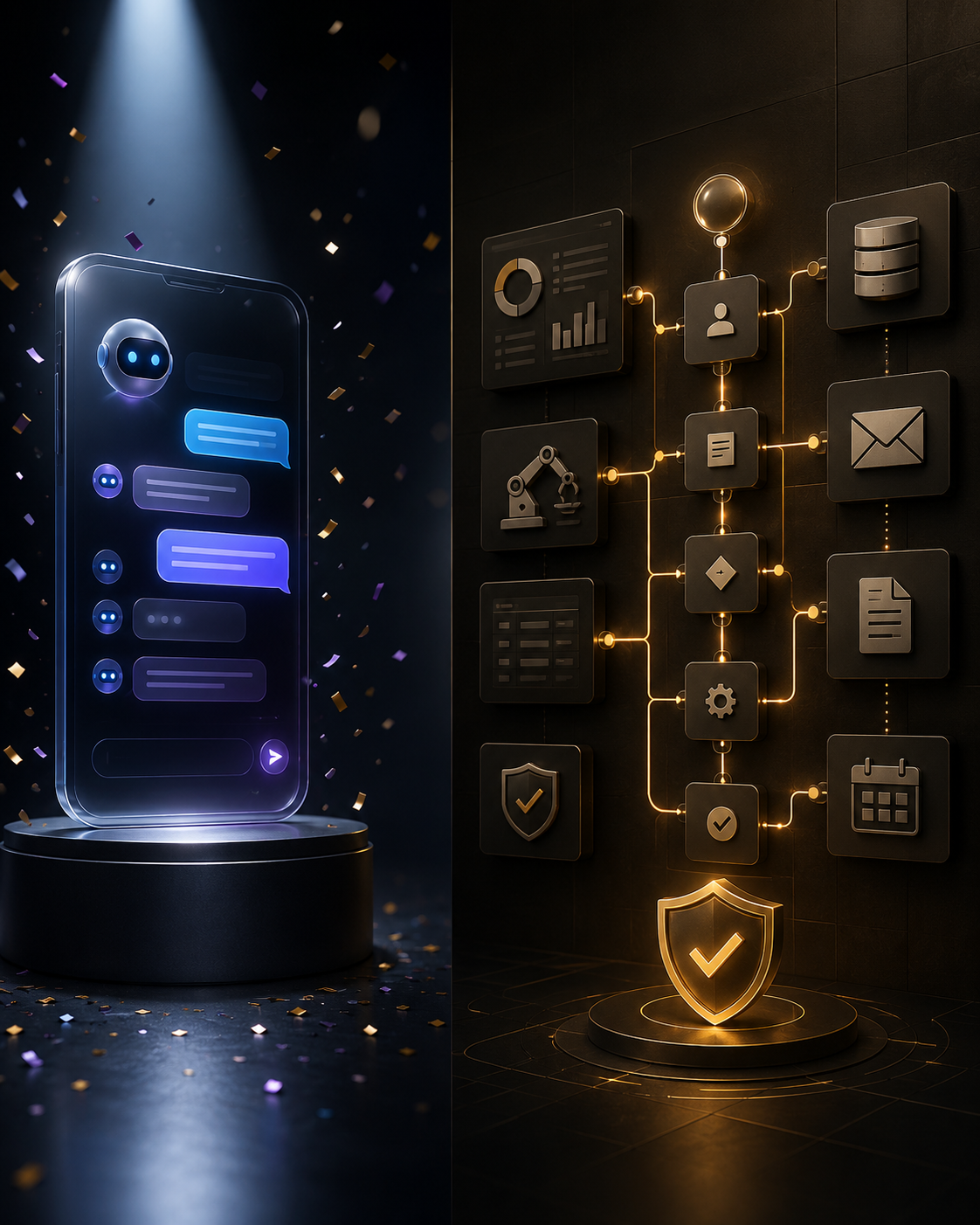
For the past two years, most people have interacted with AI through chat interfaces.
Open a browser. Write a prompt. Get an answer.
That model worked because it made AI accessible. It lowered the barrier to entry and allowed millions of people to experience language models for the first time.
But something is starting to change.
Among developers, operators, technical teams, and people building real systems around AI, the center of gravity is slowly moving away from "chat" and toward execution.
Not because chat interfaces are bad. Not because the models failed.
Actually, the opposite.
The models became good enough that intelligence is no longer the primary bottleneck.
Execution is.
The Real Problem Was Never Writing Text
Most operational work inside a business does not happen in a chat window.
It happens across:
- documents
- spreadsheets
- CRMs
- inboxes
- APIs
- internal tools
- approval systems
- dashboards
- workflows
- repetitive operational processes
This is why tools like:
- Cursor
- Codex
- Claude Code
- Hermes
- OpenClaw
are becoming increasingly important.
The interesting part is not that they can generate text.
The interesting part is that they can operate.
They can:
- edit files
- interact with systems
- execute workflows
- maintain context
- orchestrate multiple steps
- use tools dynamically
- interact with real operational environments
That changes everything.
We're Moving From "AI That Answers" to "AI That Operates"
For a while, the industry focused heavily on prompt engineering and chatbot experiences.
But businesses do not fundamentally need "better conversations."
They need:
- faster operations
- fewer repetitive tasks
- better execution consistency
- reduced manual overhead
- systems that scale without proportional headcount growth
This is where operational AI becomes far more important than conversational AI.
The next generation of AI systems will not simply answer questions. They will participate in workflows.
Instead of: "Here's how you could do this."
The system becomes: "I already handled it."
That transition is much larger than most people realize.
The Hidden Shift Happening Right Now
Today, most advanced AI workflows still require technical setup.
You need to understand:
- APIs
- integrations
- terminals
- GitHub
- MCP servers
- authentication
- tooling
- orchestration layers
For technical users, this is manageable.
For the average business operator, it is not.
That is why the current generation of operational AI tools still feels early.
The underlying capabilities are already extremely powerful. But usability and abstraction are still catching up.
Eventually, the winning systems will likely combine:
- simple conversational interfaces
- persistent memory
- operational context
- workflow execution
- proactive behavior
- deep integration into business systems
In other words: the future probably still looks like "chat" on the surface.
But underneath, it becomes an operational layer capable of executing real work.
Why This Matters for Businesses
A lot of companies are still approaching AI as a standalone tool purchase.
They ask: "What AI chatbot should we use?"
That is usually the wrong question.
The better question is: "What operational bottlenecks should we remove first?"
Because the real leverage does not come from adding another AI interface.
It comes from:
- redesigning workflows
- orchestrating systems
- reducing handoff friction
- automating repetitive execution
- embedding intelligence directly into operations
This is also why many AI initiatives fail.
Companies buy tools before understanding workflows.
They optimize interfaces instead of operational systems.
The businesses seeing real results are usually the ones focusing on:
- operational sequencing
- workflow design
- integration
- reliability
- measurable business outcomes
Not hype.
Not demos.
Not "AI magic."
The Future Is Operational
The long-term direction seems increasingly clear.
AI systems will become:
- more integrated
- more contextual
- more autonomous
- more proactive
- more operationally embedded
The best AI systems will eventually behave less like chatbots and more like highly capable operational teammates.
You will not need elaborate prompts. You will not need to explain every detail repeatedly. You will not need to manually orchestrate every task.
The system will already understand:
- your workflows
- your tools
- your context
- your priorities
- your operating patterns
And over time, the interaction layer itself may become almost invisible.
Not because chat disappears. But because execution becomes the real product.
At AIx Automation, this is exactly why we focus on workflows before tools.
The future of AI is not just better conversations.
It is better operational systems.